Urban Revitalization - The Peoria Warehouse District


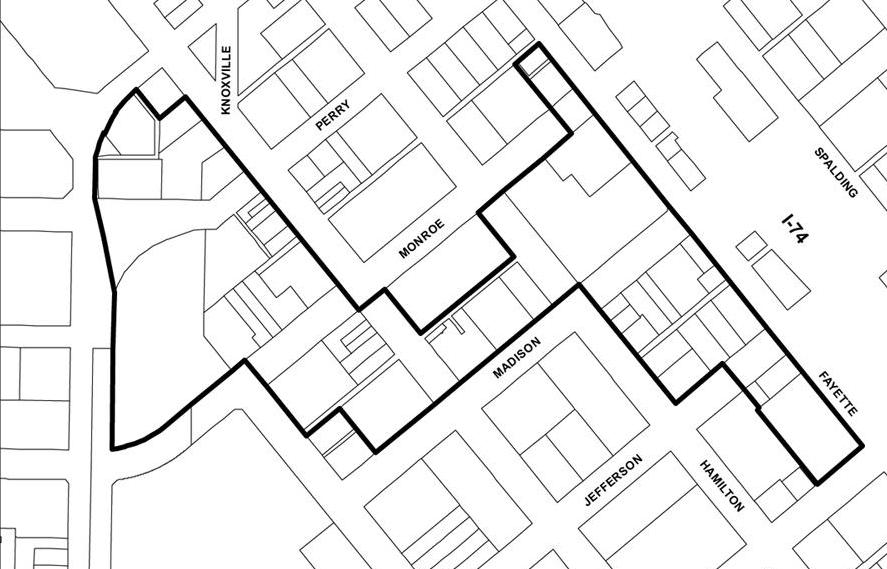
The area just south of downtown Peoria was a decaying mix of old industrial lofts, one story industrial buildings, and vacant lots. The City developed a plan to transition this area to a vibrant mixed - use residential and commercial neighborhood. Some of the old industrial lofts are being converted into condominiums. The street level space will become viable commercial areas as residents are attracted to the area.

The conversion of this area to a great urban neighborhood will take place as a result of market demand and the strong incentives the City has created. The area is in a TIF and Enterprise Zone. The City will use 50% of new property taxes generated for City improvements, and 50% allocated to developers to finance environmental clean up, public safety improvements, and rehabilitation to uses permitted in the new Form Based Code. This will lead to very rapid redevelopment. The incentive would be for buildings started in the first five years – after that taxes from new buildings would flow directly to the taxing bodies.

The consulting firm Ferrill-Madden projects that the Warehouse District can support 180 dwelling units per year, with a total of 3,600 new homes by 2025. The consultant also projects 220,000 square feet of commercial space developed over the next 20 years. Land owners and developers are encouraged to redevelop their property. The City will provide a draft development agreement. TIF studies should be complete in July 2007.

This plan will implement the Heart of Peoria Plan, improving our beautiful downtown and Riverfront with converted lofts, new housing, offices and retail businesses. The area will become the hot new neighborhood in Peoria. Property owners and developers are encouraged to help make this great neighborhood happen now.

The City of Peoria is mounting an aggressive effort to attract new investment to our vibrant community. Our unemployment rate is very low. We have redeveloped our beautiful waterfront. Our hospitals and clinics are adding numerous highly paid employees, many of whom want to live in or near downtown.

INCENTIVES

The District is currently in an Enterprise Zone. Building materials are tax exempt.

Structures built before 1936 are qualified for a 10 to 20% Federal historic tax credit.

The City has worked with the State to create a 20% State tax credit, which has not yet been approved.

The TIF was adopted on June 24, 2007, and will provide incentives for 23 years.

The City has applied for numerous grants to assist in this redevelopment effort.


[warehouse+district+brochure+pg+1.jpg]


[warehouse+district+brochure+pg+2.jpg]


[Big_BUild_07-14-08.jpg]


Craig Hullinger was the Economic Development Director for the City of Peoria from 2005 to 2009 can be contacted at

craighullinger@gmail.com


309 634 5557


TIF Works - Tax Increment Financing

TIF Works
Tax Increment Financing
TIF is Not a Four Letter Word


Tax Increment Financing is a very effective but controversial method to help redevelop older areas within a city. It is poorly understood and often unfairly criticized. TIF is not a four letter word.

What is Tax Increment Financing?


The Illinois Tax Increment Financing Association http://www.illinois-tif.com/ provides an excellent explanation of TIF. Tax Increment Financing helps communities revitalize older and declining neighborhoods. A District is created following the requirements of the law. The new property tax generated in the new District can be used to assist development in the district, helping the area revitalize.

Case Studies

The City of Peoria has developed 10 TIF Districts. The value of these areas was initially very low. The TIF helped these areas redevelop, and the value of these areas has gone up on average 23% each year, much faster than the city as a whole. Nearby areas without the TIF have had little improvement in value. And of course the redeveloped areas created jobs and vitality.

Depending on the rate of taxation, taxes paid by the new development may be as much as or more than one half of the fair market value of new and redeveloped buildings over the 23 year life of the TIF. The city can provide some or all of that increment back to the developer to help make the project a reality.

TIF Districts incent redevelopers, spurring revitalization of older neighborhoods and increasing jobs. Cities have stimulated substantial new investment through public/private partnerships.

The Illinois Medical Clinic to the right received a 4 million dollar TIF incentive to construct in downtown. The funds helped the developer pay for a parking deck. But for the TIF incentive, this great job and tax producing building would have gone to suburban areas. Instead it helps to revitalize the older central city.

Tax Increment Financing is controversial. But there is no question that it is a great way to build tax base and jobs. The Southtown TIF is the oldest TIF in the City of Peoria and one of the oldest in Illinois. The graph shows that the value of real estate within the TIF grew much faster than the City and School District 150. In 2013, the TIF will be completed, and the tax revenues will go to all the local governments.

The City of Peoria created two new TIF’s in 2007. The areas were very blighted, and growth of jobs and tax base in the areas lagged far behind the remainder of the city.

The chart and graph shows the performance of the two new TIF’s compared to the entire city and the school district. The two new TIF’s have grown much faster than their parent taxing bodies.

Village of Saunemon

TIF is effective in large cities and small villages. The Village of Saunemon created a TIF to assist the development of a gas station and convenience mart. Residents had previously needed to travel a substantial distance to purchase gas and convenience items. The TIF enabled the Village to recruit a developer to bring these needed services to the community,

We believe these numbers support the continued use of Tax Increment Financing. We want our older neighborhoods to thrive and improve, and TIF is one of the best ways to help that process.

More info at:
Illinois Tax Increment Financing Association http://www.illinois-tif.com/


TIF Illinois http://www.tifillinois.blogspot.com/


City of Peoria http://peoriatif.blogspot.com/

Warehouse District http://warehousedistrict.blogspot.com/


Beth Ruyle is a partner in the planning and economic development consulting firm Ruyle Hullinger and Associates. She was the Executive Vice President of Ehlers and Associates, Executive Director of the South Suburban Mayors and Managers Association for 22 years, and a City Planner with the Atlanta Regional Commission. She can be contacted at


309 966 1616

Bethruyle@gmail.com


http://Bethruyle.com


Craig Hullinger AICP is a partner in the planning and economic development consulting firm Ruyle Hullinger and Associates. He was formerly the Director of Economic Development for Peoria, Village Manager of Olympia Fields, University Park and Minooka, Planning Director for Will County, and a Colonel in the Marine Corps Reserve. He can be reached at


309 634 5557
craighullinger@gmail.com

http://craighullinger.com


TIF (Tax Increment Financing) Works


The Partners of Ruyle Hullinger have completed over 50 Redevelopment Plans with Tax Increment Finance (TIF) Districts and District Amendments.


http://ruhu12.com/


EXAMPLES


TIF PLAYS IN PEORIA


The photos show existing and proposed redevelopments in TIF's in Peoria that took place in the past three years. The consulting team worked with City staff, Camiros, and the City Council to iniate and complete the redevelopment plans for three tax increment financing districts approved in 2007-2008. A total of eighteen (18) buildings have been approved for development or redevelopment in the three new and one existing TIF’s.


Total investment in the buildings will be approximately $178,000,000, creating over 1,000 jobs.


This during the “Great Recession”.


And there are many more buildings in the works.


0 comments


Hotel and Convention Center TIFs


The consulting team worked with city staff and consultants to initiate and complete redevelopment plans to bring new convention center hotels to the communities of Peoria and Tinley Park. The cities used the TIF to pay for improvements to incent the redevelopment of the hotel and convention center. The consultants also initiated successful developer recruitment efforts, and helped the city negotiate the complex agreements required to complete the hotels.


Downtown hotels and other hospitality industry business struggle to compete with quality new developments. A City can choose to compete or not to compete. A Tax Increment Financing District can assist existing and new businesses invest, improve, and expand.


Hospitality Improvement Zone Peoria Illinois (HIZ) TIF


The City of Peoria has a quality convention center. But a new attached hotel is a requirement for the convention center to compete for conferences and conventions.


In 2008 the City created a Hospitality Improvement Zone (HIZ) Tax Increment Financing District (TIF) and a Business Development District (BDD). City staff worked with Camiros to conduct the property and building surveys that determined that the area qualified for the TIF and BDD. The TIF captures the new property tax that will be generated by the new hotel improvements over the next 23 years, and puts part of those funds back into the development. The BDD enables the City to pass a new hotel tax and a new sales tax of up to 1% to put back into the redevelopment. The maps below show the boundaries of the TIF and BDD, and the illustrations depict the proposed hotel improvement.


More info at:


http://hospitalityimprovementzone.blogspot.com/


http://peoriatif.blogspot.com/


http://hotelpeoria.blogspot.com/


Hotel and Convention Center Redevelopment Tinley Park, Illinois


Tinley Park, Illinois


The consulting team worked with the Village of Tinley Park to create the incentive programs for the development. The consulting team recruited the successful developer and helped negotiate the complex redevelopment agreement. The TIF paid for the land acquisition, infrastructure, and construction of the Convention Center. This incentive made it possible for the developer to construct the hotel. The development has been very successful, and is located at I-80 and Harlem (Route 43) in Tinley Park, Illinois.

Preparing an Economic Development Strategy


PREPARING An ECONOMIC DEVELOPMENT STRATEGY
IN

TEN EASY STEPS

By
Chuck Eckenstahler and Craig Hullinger

3/6/2009

Introduction
Every local governmental official is now challenged with the need to promote jobs and new investment in their community. The question asked is “How does our community accomplish this task?”

This question is often answered by chamber of commerce members, government employed professional economic developers, and/or an assembled group of academics. These individuals usually work with a large group of interested individuals offering their opinions of what programs and activities should be undertaken by businesses and government to stimulate the local economy.

The recommendations might include an improved effort to retain existing businesses or an effort to attract new businesses. Tasks could also include developing a business park or improving education to provide more skilled employees. It may also include efforts to improve our neighborhoods and downtown business districts to attract young well-educated adults who wish to live and work in an attractive and exciting community.

The responses differ, typically having as many variations as there are people discussing what should be done. To the lay person preparing the community economic development strategy can be an overwhelming and complex task; being something “best left to the professionals.”

The truth is that strategic economic development planning is rather simple. It is not rocket science. This article seeks to demystify preparation of an economic development strategy, simplifying the process into ten easy tasks. By answering simple, easily understood questions, a group of people can prepare a strategic plan organizing an economic development program for their community.


Question 1 - Who are we?
A simple question! Yes, we know we are a community of, for example, 5,000 people. That’s correct, but what do we know about ourselves? How many people do we have in the workforce and what are their ages? What jobs do they do and how much and what type of education do they have? How many are unemployed or underemployed? How many kids are in school, when will they graduate, how many will go on to college and how many will obtain other advanced technical training?

Many of these questions can be answered by data obtained primarily from the US Census. This information can provide a narrative and quantified description of who we are and who makes up the workforce. It can also identity their education and job skills. According to business site locators, available workforce is one of the top criteria of any firm seeking to expand or locate a new business operation.

Question 2 - What is our economy?
It is usually simple to identify the major employers. This typically includes school district and hospital. The city or county government and a few major businesses are also major employers. They account for a substantial number of jobs located in the community. However, there is a large segment (some estimate 80%) of jobs that are provided by smaller business that often times are overlooked in this simple tabulation and small businesses are the primary generator of new jobs.

Data from the US Census, US Department of Commerce and state employment agency can be useful in providing a narrative and quantified description of the number and type of jobs in the community. This data allows examination of the number of jobs and wage scale of the current jobs in the community. It can also help identify the growth (or decline) of these jobs over time, which is important to know to determine what specific jobs the community currently has and what types of jobs that the community would like to attract.

Question 3 - What are our problems and opportunities?
This is a more difficult question answered by a detached unemotional critical evaluation of “community competitiveness”.

One way to answer this question is to complete what researchers call a “SWOT” analysis. To complete a SWOT analysis, the community lists its economic Strengths, Weaknesses, Opportunities and Threats.

The completed list provides information identifying unique opportunities for existing business expansion and opportunities for recruiting new businesses. It also identifies weaknesses and future threats which may discourage business expansion and new business location, which may be remedied by specific community action.

For example, the SWOT analysis might disclose that the workforce has a concentration of skilled computer operated machine tool makers. This workforce can be offered to prospective businesses needing such workers. It may also disclose that the farmland designated for industrial development has no water and sewer and is not “shovel ready” for a business to immediately begin construction.

Question 4 - What are our strengths?
Like a well trained prize fighter, who patiently waits to use his “best punch” to win the fight, an economic development strategy must identify the community’s economic development “best punch”. Completing the SWOT analysis helps identify unique economic strengths that can define the “economic development knock-out punch” for use in the fight to create new employment opportunities in the competitive global environment.

Identifying the “knock out punch” is sometimes easy. It might be a unique geographic location affording superior logistic transportation amenities. Or it might be proximity to a nationally rated university. Or perhaps it might be a young highly educated available workforce. It could be an attractive recreational or small town residential lifestyle that the community offers to new residents. Regardless of the type of strengths identified, analysis of community strengths is necessary to select those specific opportunities that can be used to create new jobs within the community.

Question 5 - What do we want to be - our future vision?
Of the ten questions, this question is the most difficult to answer - what do we want to be?

This question is most often answered by a carefully worded vision statement, prepared by the consensus of interests that places into words a mental image of what the desired future should be. The phrase “Our Future Vision is that our community will be the premier regional location for business investment in 2015” is an example of a vision statement.

This statement tells a big story. It proposes that the community will be the premier location for new business investment when compared surrounding areas. It also provides a means to measure comparative success by measuring economic indicators such as 1) increased jobs, 2) an increase in number of businesses and 3) and an increase in business tax base within the community. It also gives a time period to measure success.

Question 6 - How do we get there?
With an understanding of our strengths, weaknesses and opportunities plus a vision of what the community wants to be in the future, answering this question may become clear. The answers become a list of specific actions that must be completed to either eliminate defined weaknesses, or maximize identified strengths to capitalize on identified opportunities.

For example, the lack of “shovel ready” sites can be remedied by investment in utilities, roads, and governmental approvals necessary to have the site ready for construction immediately upon receipt of a building permit. Another action may be a Tax Increment Financing District or a Business Development District or a Special Service Area to provide incentives for business investment. Other actions may include completion of community appearance projects, securing worker skill training programs for laid-off workers, or conducting a national marketing program to recruit new businesses to locate in the community.

Question 7 - What resources do we have and need?
Every community has resources, typically scattered among a large number of separate organizations. Key to answering this question is identifying these resources and involving them in developing the economic development strategic plan with agreements to “take-on” and fund specific work tasks.

A chart can be prepared listing the specific work task identifying the person or organization that is responsible for the task, when the work is to be completed and how it will be funded. Preparing this chart early in the strategic planning process also identifies work tasks that do not yet have a sponsor or funding.

In our example, a work task to install infrastructure for a “shovel ready site” may be assigned to the city public works department. Obtaining necessary planning and zoning approvals would be a task for the city Planning Department. The City Council could be assigned responsibility to begin city council sponsorship of a TIF district for a future business using tool making machinery equipment. The Community College could be asked to sponsor a workforce retaining effort with the chamber of commerce assigned the task of developing and implementing a marketing program.

The chart may also identify the need to involve other organizations or recommend formation of new entities to carry out specific works tasks. We might need a downtown development organization to sponsor a downtown redevelopment plan or a neighborhood redevelopment organization to sponsor redevelopment programs.

Question 8 - Who is responsible?
The key to successful implementation requires gaining commitments from specific individuals to complete work tasks. This “buy-in” of responsibility is critical to success.

In our model economic development strategy, the Mayor, Public Works Director, City Planner, Economic Development Director, President of the Community College and Chamber of Commerce Director would be named as “responsible parties” and charged with the duty to complete one or more specific work tasks.

Question 9 - How much does it cost?
Undertaking an economic development program costs money, typically more that any single organization has within their budget. Answering this question establishes a budget for each work task and identifies who is to provide the funding for the task.

Question 10 - How do we know when we get there?
In every successful economic development program the progress towards completion of each work task is periodically reported. It gives the opportunity to celebrate success and to modify the tasks if necessary to assure successful accomplishment.

Measurement tools to gage progress are critical. Useful milestones to measure success should be included as part of the Strategic Plan.

Some strategies break the process down into a number of separate categories, such as logistics, health care, energy, agri-business, retail, etc. Other approaches include a much quicker and simpler process, with the development of a on page strategy. This approach can sometimes be used as an interim until a full blown strategy can be developed.

On Line Examples

The following web pages show examples of recent Economic Development Strategies. Each effort is somewhat different, but most of them follow most of the ten items.


Conclusion
Preparation of an economic development strategic plan is not an overly complex process and can be accomplished by answering ten questions to define a Vision for an economically improved community. Specific answers lead to identification of weaknesses that need to be remedied. The process also identifies strengths and specific opportunities with can serve as the base for a job expansion and business investment program. It provides a mechanism to identify specific work tasks, determine their cost and assign responsibility for their completion and means to measure incremental progress.

There are numerous resources to help communities prepare economic development strategies, including regional planning organizations and private consultants. While use of outside assistance brings technical skills and greater experience to the process, community representatives are still required to answer all ten questions, develop the vision and work tasks, and accept responsibilities to complete each work task.


___________________


Economic Development Strategy Questions
1. Who are we?
2. What makes up our economy?
3. What are our problems and opportunities?
4. What are our strengths?
5. What do we want to be - our future vision?
6. How do we get there?
7. What resources do we have and need?
8. Who is responsible?
9. How much does it cost?
10. How do we know when we get there?

EXAMPLE STRATEGIC PLAN WORK TASK CHART


ECONOMIC DEVELOPMENT STRATEGIC PLAN
Work Tasks
Work Task
Description
Budget
Funding
Source
Responsible Party
Completion
Date
Progress
Measurement
Tool


Easy to Print Link Below:

http://docs.google.com/Doc?id=dgp5tpcd_118pjfvkng6&btr=EmailImport


About the authors -


Chuck Eckenstahler is 35 year veteran of municipal planning, economic development and real estate consultant serving clients in Illinois, Indiana and Michigan, and a past contributor to the Illinois Municipal Review. He teaches economic development subjects in the Graduate School of Business at Purdue North Central, Westville, Indiana and serves on the faculty of the Lowell Stahl Center for Commercial Real Estate Studies at Lewis University, Oakbrook Illinois. He can be contacted at pctecken@comcast.net or by phone at 219-861-2077.


Craig Hullinger AICP has 35 years of experience in economic development, city planning, and transportation planning. He is a Economic Development and City Planning Consultant. He was the Economic Development Director of the City of Peoria, Illinois, and a member of the American Institute of Certified Planners and Lamda Alpha. He was formerly Planning Director of Will County. He publishes a number of blogs on economic development. He can be contacted at craigullinger@gmail.com or by phone at 309-634 5557.

Façade Improvement Programs

Façade Improvement Programs:
Getting the Private Sector Involved in Downtown Revitalization

Authors: Craig Hullinger, AICP and Diane Gormely-Barnes, AICP


A Facade Improvement Program can be a cost effective method of encouraging private sector reinvestment in older commercial areas. A program will usually provide partial funding for appropriate facade improvements that both enhance the appearance of the building and contribute to the overall character of an historic commercial area or central business district (CBD), most often as part of a larger improvement program.

The Village of Tinley Park, Illinois undertook a transit-oriented development (TOD) plan in 1998 that was sponsored by the Regional Transportation Authority of Northeastern Illinois (RTA). The RTA’s Regional Transportation Assistance Program (RTAP) provided matching funds for the development of the plan. The TOD plan was essentially a downtown improvement plan, focusing on enhancements to the train station area within the historic commercial core of the community. The community planning process, led by the Chicago-based planning firm of Camiros, Ltd., resulted in recommendations to enhance the appearance and viability of the “Old Town” area along Oak Park Avenue, adjacent to the Metra station.

Train stations were the focus of many communities when rail transport was king. The CBD of Tinley Park developed around the train station, a stop on the famous Rock Island Line. Most businesses and homes were within easy walking distance of the train station. As the town grew and the auto became dominant, wider modern roads diverted traffic away from the historic commercial buildings adjacent to the train tracks. The station area declined in importance and became a minor center relative to the large commercial centers developed at the intersections of major roads elsewhere in Tinley Park. The Village became concerned about the deterioration of “Old Town” and also recognized that some of the buildings no longer exhibited a character appropriate for an historic area, due to modern era renovations.

The TOD plan included numerous proposed improvements to Metra facilities, and also many landscaping, streetscaping and marketing enhancements. The Village and Metra have moved aggressively to implement the public sector initiatives of the plan, and a number of improvements have been made or are underway. These include the removal of an unsightly water tower near the tracks, parking lot and sidewalk upgrades, installation of a plaza near the station to serve as a community gathering space and CBD focal point, and the ongoing construction of a new Metra station. A new mixed-use building containing retail space and condominiums is also under construction on a key site in the area.

A very important and effective part of the plan was the development of Façade Improvement Guidelines, and the preparation of several specific facade improvement concepts for high visibility buildings in the area. The Guidelines address three specific development types found in the station area: traditional commercial facades built up to the sidewalk, auto-oriented buildings set back from the street, and older residences that have been converted to business use. Each façade improvement concept included a detailed illustration of the potential future appearance of the façade, juxtaposed with a photograph of the existing condition of the building. The sketches provided an improvement recommendation that each building owner could pursue with an architect or directly with a general contractor, depending upon the scope of the proposed façade changes.

The Village of Tinley Park then developed and marketed a Façade Improvement Program for buildings in the CBD, beginning with building owners for whom the Village had proactively funded improvement concepts. Under the Program, the building owner hires an architect acceptable to the Village to design (or in these cases refine) a façade concept and estimate the cost of the improvements.  Drawings are then submitted to the Village.  If approved, the Village reimburses the building owner for up to 50% of the cost of the façade improvements.

A picture is worth a thousand words. Village staff used the facade improvement concepts in meetings with property owners, the business community, and developers. The sketches were very effective in developing interest in building improvements by the private sector. Several buildings in the immediate area of the train station have been attractively renovated and house thriving restaurants that are highly visible to passing Metra commuters, providing outdoor dining areas and substantial new downtown activity, jobs, and sales tax revenue.

A Facade Improvement Program is a low cost and effective way to attract quality investment to a community. The facade improvement concepts were a very important outgrowth of the TOD plan.  They encouraged the active involvement of the private sector in area improvements. The improvements generated by the TOD plan and Facade Improvement Program jump-started a successful effort toward community revitalization.

The authors:

Craig Hullinger, AICP is a city planning consultant.  He can be reached at: 


Diane Gormely-Barnes, AICP, AIA, LEED AP 
 
is currently a Principal Planner with HNTB Corporation in Chicago, Illinois.  She was formerly a Senior Associate at Camiros, Ltd.  She can be reached at dcbarnes@hntb.com.

For more information on Tinley Park’s Façade Improvement Program and other “Old Town” initiatives, contact: Director of Planning for Tinley Park, IL at 708 444 5000.


Posted by Picasa
The façade improvements at Ed and Joe’s Pizzeria were also based on historic photographs.  The decorative wooden façade and signage replaced dark, diagonal wood siding that had been installed in recent decades.


Posted by Picasa
Teehan’s Tavern was upgraded with ground floor storefront improvements and new siding and trim above.  A raised outdoor seating area was also added to enliven the street.


Posted by Picasa

Façade improvements proposed for the Holstein’s Saloon building were based directly on photographic evidence of its historic appearance in the early 1900s.  The new façade replaced a plain brick front that had been installed over the original ornate wooden façade.  A raised outdoor dining area was also created.